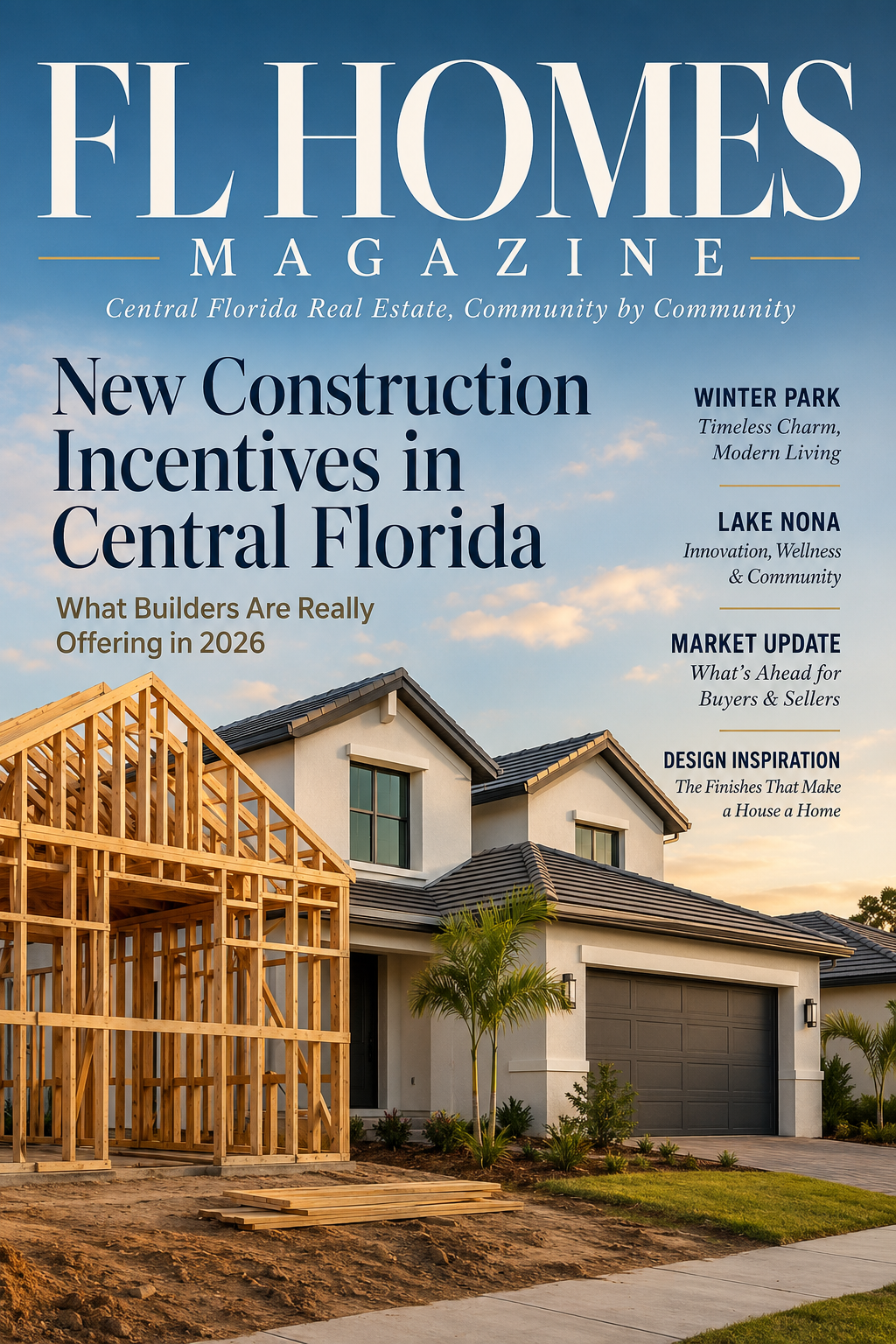
New Construction Incentives in Central Florida: What They Actually Save You
| Incentive Type | Typical Value | The Catch |
|---|---|---|
| Closing cost credit | $5,000–$15,000+ | Usually requires the builder's preferred/affiliated lender |
| Temporary rate buydown (2-1) | 2 points off year 1, 1 point off year 2 | Reverts to the full note rate in year 3 |
| Permanent rate buydown | Flat lower rate for the full loan term | Paid for upfront through points at closing |
| Design center / upgrade credit | Varies by builder and community | Usually can't be applied toward closing costs |
| Quick move-in (spec) discount | $20,000+ off already-built inventory | Limited to whatever's already built — no customization |
New construction buyers in Central Florida are being offered real money in 2026 — the question is which incentive actually helps your specific situation, and which one just moves cost from one column to another.
What Kinds of Incentives Are Builders Actually Offering?
Most Central Florida builder incentives fall into a handful of categories: mortgage rate buydowns, closing cost credits typically in the $5,000 to $15,000 range, design center or upgrade credits, and price reductions on already-finished "quick move-in" inventory homes. Builders rarely combine all of these on one home — more commonly, a buyer chooses which incentive matters most and negotiates around it, since builders structure offers to steer buyers toward whichever incentive protects their own margin and appraisal comps the most.
Rate Buydowns: Permanent vs. Temporary
A permanent buydown locks in a flat, lower interest rate for the entire 30-year term, paid for upfront by the builder through points at closing. A temporary buydown, most commonly a 2-1 structure, drops the rate by two points in year one and one point in year two, then settles at the full note rate for the remaining term. The temporary version front-loads savings into the first couple of years, which helps if income is expected to rise or if the plan is to refinance before the discount expires; the permanent version is the better fit for buyers planning to keep the loan long-term. Both typically require using the builder's affiliated lender to qualify.
The Preferred-Lender Catch
Nearly every major production builder — DR Horton, Lennar, Pulte, and similar national builders active in Central Florida — offers financing through an in-house or affiliated mortgage company, and the incentive is usually conditional on using it. Federal law under RESPA requires builders to disclose this financial relationship and confirms buyers cannot be required to use the affiliated lender as a condition of purchasing the home — the incentive can be conditional, but the sale itself cannot be. In practice, a builder's preferred lender might offer a meaningfully higher rate than an independent lender would, with the incentive dollar amount meant to offset that gap. Whether it actually does depends on the math, not the sales pitch.
The incentive can be conditional on using the builder's lender — the sale itself legally cannot be.
Why Builders Almost Never Cut the List Price
Builders structure nearly all of their incentives as credits, buydowns, or upgrades rather than a straight price reduction, because the list price sets the appraisal comparable for every other home they still need to sell in that same community. A $20,000 price cut on one home can drag down the appraised value for the builder's entire remaining inventory nearby; a $20,000 closing cost credit accomplishes something similar for the buyer without leaving that footprint in public records. Understanding this is useful context when negotiating — asking for a bigger incentive is usually a more realistic ask than asking a builder to simply lower the price.
Design Center Credits: The Upgrade Trap
Design center or upgrade credits can be a genuine perk when they cover finishes a buyer would have paid for anyway — flooring, cabinets, countertops — but they typically cannot be applied toward closing costs, and they can tempt buyers into over-upgrading a home beyond what neighborhood comps will support at resale. Before treating a design credit as "free money," it's worth asking whether the specific upgrades being offered are ones the buyer would genuinely choose and pay for out of pocket, or whether the credit is really steering spending toward options that primarily benefit the builder's margin.
Quick Move-In Inventory: The Other Kind of Deal
Builders sometimes discount already-completed "quick move-in" or spec inventory homes by $20,000 or more, particularly toward the end of a sales phase or fiscal quarter. These homes trade customization for savings and speed — what's built is built, but the discount is usually a real price reduction rather than a credit, and the closing timeline is typically much faster than a to-be-built home, which can matter for buyers on a deadline.
Florida-Specific Costs an Incentive Won't Cover
A closing cost credit doesn't offset two costs that are specific to new Florida construction: Community Development District (CDD) fees, which fund infrastructure in many newer master-planned communities and can add a meaningful amount to the monthly payment, and the year-two property tax reassessment that typically applies once a new home is fully assessed at its completed value rather than land-only. A credit that saves $10,000 at closing can be outweighed within a couple of years by CDD fees and a higher-than-expected tax bill if those costs weren't part of the original budget.
The Math to Actually Run Before Deciding
The only way to know whether a builder incentive is actually worth it is to get a full Loan Estimate from the builder's preferred lender and at least one independent lender, then compare total cost over the realistic time the loan will actually be held — not the full 30-year term if a move or refinance is likely sooner. A simple breakeven calculation (incentive dollar amount divided by the monthly savings from a lower-rate independent loan) shows how many months it takes for the independent option to catch up; if the plan is to keep the home well past that breakeven point, the independent lender often wins despite losing the incentive.
Builder Incentive vs. Independent Financing
Taking the Builder's Incentive
- Real credit toward closing costs or a lower early-year rate
- Simpler process, one point of contact for home and financing
- Often faster to qualify since the lender knows the community/project
Going With an Independent Lender
- Often a genuinely lower rate, no incentive strings attached
- Can be the better choice for buyers keeping the home long-term
- Requires running the numbers yourself — no built-in credit to fall back on
Common Mistakes Buyers Make
- Comparing the incentive dollar amount alone instead of total cost over the expected holding period.
- Assuming the builder's rate is the best available without getting an outside Loan Estimate to compare against.
- Over-upgrading through a design center credit beyond what neighborhood resale comps will support.
- Not budgeting for CDD fees and year-two tax reassessment, which a closing credit doesn't offset.
- Assuming a price cut is on the table when a credit or buydown is almost always the more realistic ask.
Key Takeaways
- Closing cost credits ($5,000–$15,000+) and rate buydowns are the most common Central Florida builder incentives in 2026 — not price cuts.
- Incentives are usually conditional on using the builder's preferred lender, which RESPA allows — but the sale itself cannot be conditioned on it.
- A breakeven calculation, not the incentive amount alone, tells you which financing option actually costs less.
- CDD fees and year-two property tax reassessment are Florida-specific costs an incentive won't offset.
- Quick move-in inventory discounts are usually real price cuts, unlike credits on to-be-built homes.
Frequently Asked Questions
Do I have to use the builder's lender to get the incentive?
Often, yes, to qualify for that specific incentive — but federal RESPA rules prohibit builders from requiring their lender as a condition of the sale itself. Always get an outside Loan Estimate to compare.
What's the difference between a temporary and permanent rate buydown?
A temporary (2-1) buydown lowers the rate for the first two years before reverting to the full note rate. A permanent buydown locks in a lower rate for the entire loan term.
Will builders negotiate on the actual list price?
Rarely — cutting list price affects appraisal comps for the rest of their inventory in that community. Asking for a larger credit or buydown is usually the more realistic negotiation.
Are design center credits worth it?
Only if they cover upgrades you'd genuinely pay for anyway. They typically can't apply to closing costs and can tempt over-upgrading beyond what resale comps support.
What Florida-specific costs should I budget for beyond the incentive?
CDD fees in master-planned communities and a year-two property tax reassessment once the home is fully assessed at completed value — neither is offset by a standard closing credit.
Kelly Nadeau, Licensed Florida Broker BK3344334, adds that CDD fees and tax reassessment timing are the two costs buyers most consistently forget to ask about before signing a new-construction contract.
New Construction Activity in Seminole County
Seminole County continues to see active new-construction development alongside its established resale neighborhoods, particularly in areas with available land for master-planned communities. Buyers comparing new construction against resale options in cities like Lake Mary, Sanford, and Oviedo should weigh builder incentives against CDD fees and HOA structures that don't apply the same way to older, established neighborhoods.
Weighing a Builder's Incentive Against Your Options?
The professionals at Certainly Sold can help you run the real numbers — builder credit vs. independent financing, resale vs. new construction.
- Sources to verify before publication:
- Current builder incentive offers — confirm directly with DR Horton, Lennar, Pulte, and other active Seminole County builders, since these change monthly
- RESPA disclosure requirements for builder-affiliated lenders
- Seminole County CDD fee schedules by community
- Seminole County Property Appraiser — year-two reassessment timing on new construction