Florida Amendment 3: Homestead Exemption Guide
Florida voters approved Amendment 3. Starting in 2027, it can leave more of an eligible homeowner’s property value out of certain tax calculations. That may lower part of the tax bill. It does not erase every property tax or charge.
Reviewed November 14, 2026. Based on current Florida government guidance. Check with your county for updates and rules for your home.
The quick answer
For homeowners who qualify for the larger exemption, the limit is up to $150,000 in 2027 and $250,000 in 2028 for taxes outside the school district. The school-tax exemption remains up to $25,000. People who were not permanent Florida residents by December 31, 2026 generally start with a smaller exemption and reach the larger one in their fifth year of receiving homestead exemption.
What do “school,” “non-school” and “ad valorem” mean?
Your property-tax bill can include money for several different local government offices. Think of it as one envelope holding several smaller bills.
School taxes go to the school district. Homeowners can owe these taxes even if they do not have children in public school.
Non-school taxes are property taxes charged by local governments other than the school district. These can include the county, your city and certain special districts. “Non-school” tells you which part of the bill we mean. It does not mean the house has no school nearby.
Ad valorem means “based on value.” For these taxes, the government uses the home’s taxable value and a tax rate to work out the charge.
Non-ad valorem assessments are separate charges that are not calculated from the home’s taxable value. Some garbage or drainage charges are examples. A larger homestead exemption does not automatically remove them.
Important: Non-school and non-ad valorem do not mean the same thing. A county tax can be both non-school and ad valorem: it goes to the county and is based on the property’s value.
Three different values: a home’s price is not its tax bill
Market value: the property appraiser’s estimate of what the home is worth in the market.
Assessed value: the value used before exemptions are subtracted. Rules that limit yearly increases can make it lower than market value.
Taxable value: the amount left after the exemptions allowed for that part of the bill are subtracted. The tax rate is applied to this amount.
An exemption is an amount of value left out of a tax calculation. It is not a check from the government. Your notice may show different values for school taxes and other taxes.
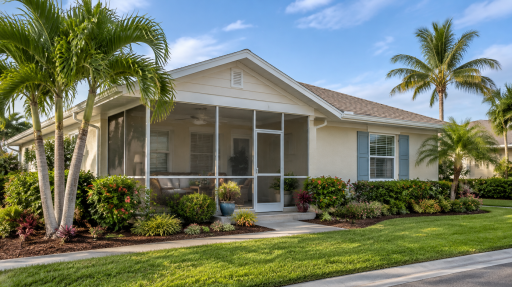
A homestead is generally your qualifying permanent home. Ask the county property appraiser which exemptions apply to your home.
A simple example: a $300,000 assessed value
Imagine a homeowner qualifies for the larger exemption in 2028. For this example, assume the assessed value is $300,000 for both parts of the bill and there are no other exemptions.
For non-school taxes: $300,000 minus the $250,000 exemption leaves $50,000 of taxable value.
For school taxes: $300,000 minus the $25,000 exemption leaves $275,000 of taxable value.
The local tax rate is then applied to each amount. The homeowner has not saved $250,000 in cash. Instead, $250,000 of value is left out of the non-school tax calculation. This $250,000 is the total exemption for that calculation, not an extra amount added on top of the old basic exemption.
When do the changes begin?
Year | What to know |
|---|---|
2026 | Amendment 3 does not lower the 2026 bill. |
2027 | The change starts January 1. The larger non-school exemption is up to $150,000 for eligible owners. |
2028 | The larger non-school exemption rises to up to $250,000 for eligible owners. |
2029 and later | The amendment provides adjustments for positive inflation. Check the amount that applies that year. |
You may hear “tax roll.” That simply means the county’s yearly list of properties, their tax values and related information. These changes first apply to the 2027 tax roll.
What if I move to Florida after 2026?
If you did not have a permanent Florida residence by December 31, 2026, you generally begin with up to $50,000 exempt for non-school taxes and up to $25,000 for school taxes once you qualify for homestead. The larger non-school exemption begins in your fifth homestead-exemption year. Count exemption years, not just birthdays or years since buying the home.
Buying a vacation home does not automatically make you a permanent Florida resident. Someone who rents a home in Florida may become a permanent resident before buying. The county property appraiser must review the facts.
What about rentals and second homes?
A separate part of Amendment 3 lowers the annual limit on certain non-homestead assessment increases from 10% to 5%, starting in 2027. It applies to the covered non-school assessments, with exceptions such as ownership changes or improvements. It is not a promise that the whole tax bill can rise only 5%. A rental or vacation home does not get a homestead exemption just because its owner lives in Florida.
What should homeowners do next?
Ask the county property appraiser which exemption you qualify for and whether any forms or proof are needed.
If you need to apply for homestead, the usual rules look at ownership and permanent residence on January 1, with a March 1 filing deadline. Ask about special situations or missed deadlines.
Read your proposed-tax notice and final bill. Check school taxes, other property taxes and separate charges.
If you move, ask about Save Our Homes portability. This may let you carry part of a tax-assessment benefit to another Florida homestead. It does not carry the old home’s tax bill with you.
Common homeowner questions
Will every homeowner save the same amount?
No. The home’s tax values, exemptions and local tax rates all matter. A bigger exemption does not guarantee a lower total bill if other parts of the calculation change.
Does this lower my mortgage payment right away?
Do not assume so. If your lender collects money for taxes in an escrow account, ask the mortgage servicer when it will review the account. Keep making the payment it requires.
Can a county shorten the newcomer wait?
The amendment allows a local exception process beginning on or after January 1, 2030, for a critical local need and with a two-thirds vote of the county or city governing body. Do not assume your area has an exception.
Related resources
55-plus living resources · Buying a Florida second home from out of state
Official sources
Florida Department of Revenue: how property taxes and separate assessments work
Keep learning about Florida homeownership
Explore FL Homes Magazine’s 55-plus living resources and the related magazine articles above for more Florida housing education.
This article gives general information, not personal tax or legal advice. Ask your county property appraiser about your home and application. Consult a qualified tax professional or attorney before making decisions based on your situation.
Trusted Resources
Explore our related companies. These businesses share ownership and provide separate services.
Certainly Sold — Central Florida real estate brokerage.
Smart-N-Loans — Mortgage and housing-cost education.
Elder Placement Agency — Senior housing and placement guidance.
Agency AI Lab — Business marketing and automation resources.
FL Homes Magazine — Florida housing and homeowner education.


