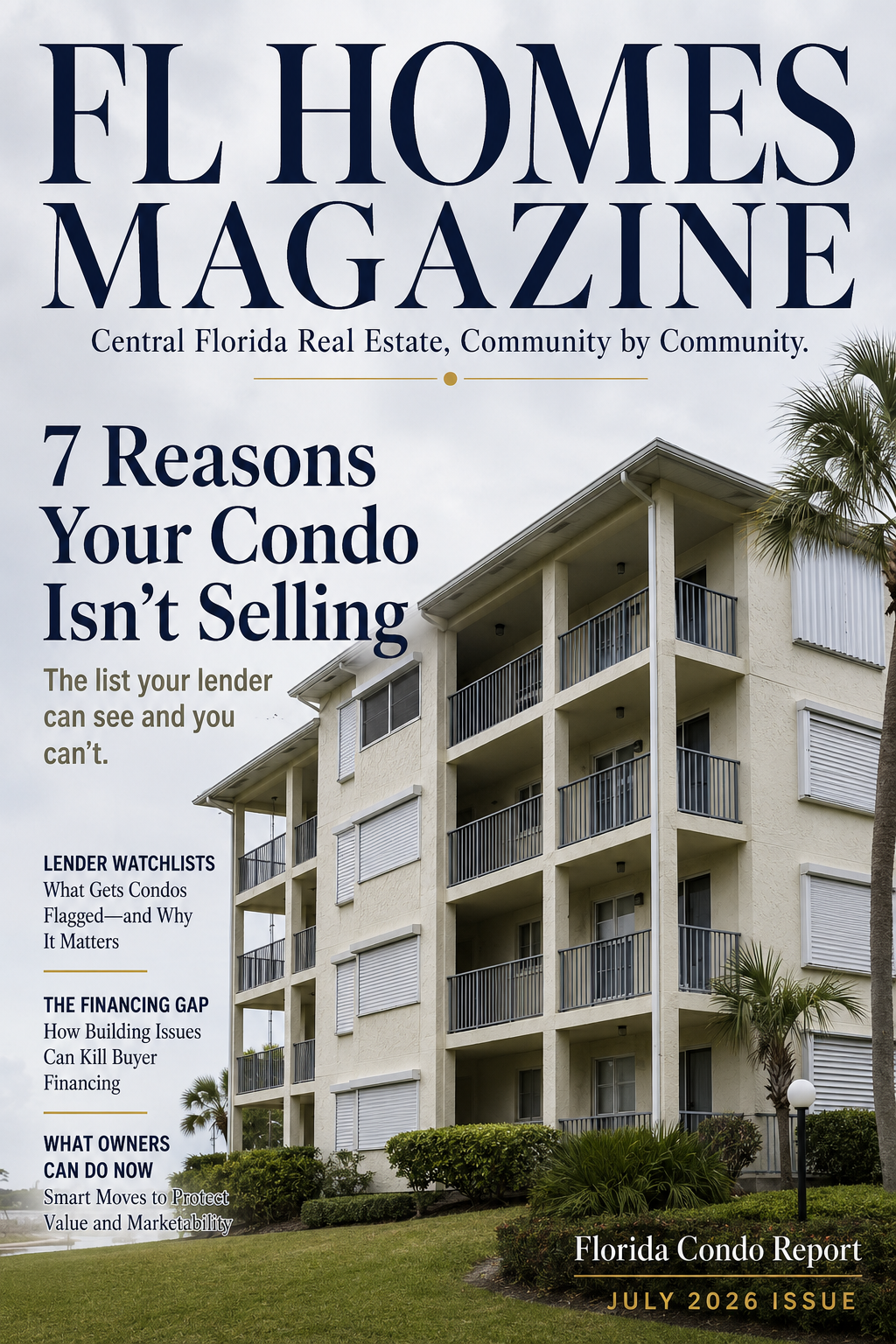
7 Reasons Your Florida Condo Isn't Selling
Before you cut the price again, check whether the problem is the unit at all. In 2026, most stalled Florida condos are stalled because of the building — and because of a list you're not allowed to see.
Florida condos are sitting because financing is failing at the project level, not the borrower level. A buyer with excellent credit can be denied because of the building's reserves, repairs, insurance or litigation. Cutting the price doesn't fix a financing problem — it just moves you toward the cash-only buyer pool.
Changing August 3, 2026
Fannie Mae is retiring its Limited Review process and Freddie Mac is retiring Streamlined Review. For loan applications dated on or after August 3, 2026, affected established condo projects generally must go through a Full Review unless they qualify for a waiver — meaning lenders examine the association's budget, reserves, insurance and financial condition, not just the buyer. If your condo is on the market right now, the pool of buyers who can finance it is about to get smaller.
Every seller in a stalled condo has heard the same three words from their agent: reduce the price. Sometimes that's right. Far more often in 2026, it's an expensive way to avoid diagnosing the actual problem — which is that a specific, identifiable feature of your building is disqualifying your buyers before they ever reach the closing table. This is how to tell which problem you have.
Which problem do you actually have?
The symptom tells you where to look. Match what you're seeing to the row below before you touch price.
| What you're seeing | What it usually means | Where to look |
|---|---|---|
| No showings at all | Price band, photos, or the building's reputation | Reasons 6 and 7 |
| Showings, no offers | Buyers are learning about fees or assessments on site | Reasons 3 and 5 |
| Offers that die at underwriting | Project review failure — not the buyer | Reasons 1, 2 and 4 |
| Only cash offers, all lowball | The building is effectively unfinanceable | Reasons 1 and 2 |
Is your building on a list your lender can see and you can't?
Fannie Mae keeps an internal report of condominium projects that are ineligible for agency financing. Loans on units in projects flagged "Unavailable" in Condo Project Manager cannot be purchased by Fannie Mae. The report circulates to lenders — it is not published for owners or associations, and lenders have been instructed not to share it.
Florida carries a disproportionate share. Data obtained by the law firm Allcock Marcus and reported in spring 2025 put Florida at 1,438 ineligible buildings, with 696 of those — nearly half — in Miami-Dade, Broward and Palm Beach counties, roughly double the South Florida count of two years earlier. The database is confidential and updated continuously, so treat that as a point-in-time snapshot rather than a live count. The direction is what matters: post-Surfside structural and reserve requirements pushed the number up sharply and it has not come back down.
This is why the pattern looks so strange from the seller's side. Three qualified buyers, three dead contracts, vague feedback each time. Nobody is lying to you. Your agent may not know either.
Do the association's reserves clear the bar?
Fannie Mae currently requires reserves of at least 10% of the association's annual budgeted income. Under Lender Letter LL-2026-03 that threshold rises to 15% for loan applications dated on or after January 4, 2027 — so an association clearing the bar today may not clear it in eighteen months.
Under Florida law, associations can no longer waive reserves for the mandatory structural components: roof, load-bearing walls and primary structural members, fire protection, plumbing, electrical, waterproofing, windows and exterior doors, and any item with a deferred maintenance or replacement cost over $10,000.
One piece of good news, because most guidance still circulating is out of date on it: the separate 50% investor-concentration cap was retired effective March 18, 2026. A high share of tenant-occupied units in your building is no longer, by itself, a Fannie Mae disqualifier. Two related tests still apply — 15% or more of units 60 or more days delinquent on assessments, and any single entity owning more than 20% of units in a project of 21 or more.
Is a rumored assessment costing you more than a real one would?
Buyers price the unknown at worst case. "There might be an assessment coming" is far more damaging than a documented $28,000 assessment with a payment schedule and a scope of work, because the first has no ceiling and the second is just math.
As of January 1, 2026, Florida associations with 25 or more units must provide owners access to governing documents, budgets and reserve studies through a dedicated website or app, and owners are entitled to view completed structural integrity reserve study and milestone reports within 30 days of completion. You have a right to the number.
Is the milestone inspection done — and what did it find?
Under Florida Statute 553.899, milestone inspections are required for residential condominium and cooperative buildings three or more habitable stories in height. Phase 1 is a visual structural examination by a licensed engineer or architect; Phase 2 follows if substantial structural deterioration is identified.
Consequences for missing a deadline escalate quickly and can include daily fines, referral for an unsafe building determination, and in serious cases a vacate order. Any of that will stop a loan.
Is it the price, or is it the payment?
The buyer's qualifying payment includes your HOA dues. Add a special assessment, a reset tax bill and Florida insurance, and a unit priced perfectly well can still be unaffordable to the person standing in it.
Dues themselves are under pressure. The building's master policy must carry replacement-cost coverage, and effective July 1, 2026 the per-unit deductible is capped at $50,000 — a change some associations are absorbing through higher premiums.
A $15,000 price cut may move the monthly payment less than a seller-paid concession would, at a higher cost to your net.
Are you priced into a bracket that hides you?
Listing at $299,900 to look sharper than $300,000 removes you from every buyer searching the $300K–$325K band. In a market where the financeable buyer pool is already narrowed, cutting your visible audience in half is an expensive way to be clever.
Are your comps from a market your buyers can't access?
A closed sale from two years ago in your building may have used a review process that no longer exists. If your building's financing status has changed since then, those comps describe a market your buyers cannot reach.
Comp against recent sales in comparably situated buildings — same age band, same inspection status, same financing reality — not against the county average or your own building's history.
A non-warrantable building is a financing classification, not a condemnation. The unit isn't unsellable. The buyer just has to come from somewhere other than Fannie Mae.
Selling into a flagged building: both sides
What works in your favor
- Cash and non-agency buyers still exist and still close
- Project status can be restored once the underlying issue is resolved
- Knowing early lets you market to the right buyer from day one
- Documented problems price better than rumored ones
- The retired investor-concentration cap removed one common disqualifier
What works against you
- A smaller buyer pool means slower absorption and more price pressure
- Non-agency financing usually costs the buyer more, which they price in
- You can't check the list yourself; you need a lender to do it
- Inspection and reserve deadlines keep running whether you sell or not
- Full Review from August 3 tightens the picture further
Common mistakes
- Stacking small reductions. Three $5,000 cuts tell buyers you're chasing the market down. One decisive move reads as intent; a slow bleed reads as desperation.
- Assuming the board knows. The ineligibility report goes to lenders, not associations. A board can tell you in complete good faith that everything is fine while the building is flagged.
- Waiting for the market to fix a paperwork problem. Nothing about a project-review failure improves with time on market.
- Hiding a known assessment. The buyer's lender finds it during underwriting regardless. The only question is whether it surfaces on day 2 or day 15, and day 15 costs you the contract.
- Trusting content that's out of date. Much of what's published about condo lending still cites rules that changed in 2026. Check the effective date on anything you read, including this.
- If contracts are dying at underwriting, it's the building, not the buyer.
- Fannie Mae's ineligible-project report is real, confidential, and heavily weighted toward Florida.
- From August 3, 2026, more projects face Full Review, so more loans will fail.
- Reserves are 10% today, 15% for applications dated on or after January 4, 2027.
- The 50% investor-concentration cap was retired in March 2026 — most published guidance hasn't caught up.
- A documented assessment prices better than a rumored one, every time.
- Non-warrantable is a financing classification. The unit is still sellable to a different buyer.
How do I find out if my building is on the Fannie Mae report?
You can't look it up yourself — it's distributed to lenders, not to owners or associations. A licensed loan originator can check the project's status directly.
My board says everything is fine. Is that reliable?
Not necessarily, and not because anyone is being dishonest. Boards frequently don't know their project's financing status, because the information doesn't go to them.
Can a building get its eligibility back?
Yes. Status can change when the underlying issue is documented as resolved. It isn't permanent, though the process is labor-intensive for the association.
Should I just wait for the market to improve?
Waiting doesn't address a project-level financing issue, and inspection and reserve deadlines continue regardless. The review changes taking effect in August tighten the picture rather than loosen it.
Do these rules apply to a two-story condo building?
Florida's milestone inspection requirement applies to buildings three or more habitable stories in height. Financing eligibility rules apply regardless of height.
From the desk of Ray Nadeau
"I hold a broker license and a mortgage license, and the condo market is where that combination matters most. An agent sees three dead contracts and reaches for the price. I can read the financing behind the offer and tell you whether the price was ever the problem. Most of the time in a stalled condo, it wasn't."
Ray Nadeau · Licensed Florida Broker BK3344407 · Mortgage Loan Originator NMLS #1027617This describes how offers are evaluated. It is not a guarantee of loan approval, appraisal outcome, or closing.
What this looks like in Seminole County
Central Florida doesn't have the oceanfront high-rise exposure that drives the South Florida numbers, but it has something that matters just as much: a large stock of mid-rise condominium buildings around Altamonte Springs, Casselberry, Winter Park and the Longwood corridor that were built in the 1970s and 1980s. Those buildings are squarely inside the milestone inspection threshold, and many are working through reserve funding requirements for the first time.
The practical effect for a Seminole County seller is that two units listed at the same price in two different buildings can face completely different buyer pools. Not because of finishes or square footage — because one association finished its structural work and funded its reserves, and the other hasn't. That's not visible in the listing photos. It shows up on day 15.
If you're deciding whether to sell now or wait, the building's compliance calendar is a bigger input than the market forecast.
- Fannie Mae Selling Guide B4-2.1-03, Ineligible Projects
- Fannie Mae Lender Letter LL-2026-03 (project review, reserves, insurance)
- Freddie Mac Bulletin 2026-C (condominium project review updates)
- Florida Statute 553.899 (milestone inspections)
- Florida Statute 718.112(2)(g) (structural integrity reserve study components)
- Florida HB 1021 (association records access, effective January 1, 2026)
- Allcock Marcus data on Florida ineligible projects, reported spring 2025
Agency guidelines carry effective dates and change. Verify current requirements with a licensed loan originator before relying on any figure here.
Find Out What's Actually Stopping the Sale
Get a straight read on why your condo is sitting — and what the realistic paths forward are.
Ray Nadeau · Licensed Florida Broker BK3344407 | Kelly Nadeau · Licensed Florida Broker BK3344334
This article is general information about the Central Florida real estate market and is not legal, tax or financial advice. References to Florida statutes, condominium inspection requirements and mortgage agency guidelines are provided for general educational purposes and are current as of the updated date shown; requirements change. Consult a licensed Florida attorney regarding your association's obligations and your own rights as an owner. Market data approximate.
Mortgage references are informational only and are not a commitment to lend. All loans subject to credit approval, program availability, and property and project eligibility. Not all applicants will qualify. Kelly Nadeau NMLS #1027618 · Ray Nadeau NMLS #1027617 · Equity Smart Home Loans CA NMLS #856170 · nmlsconsumeraccess.org · Equal Housing Opportunity.
Kelly and Ray Nadeau are licensed Florida real estate professionals.